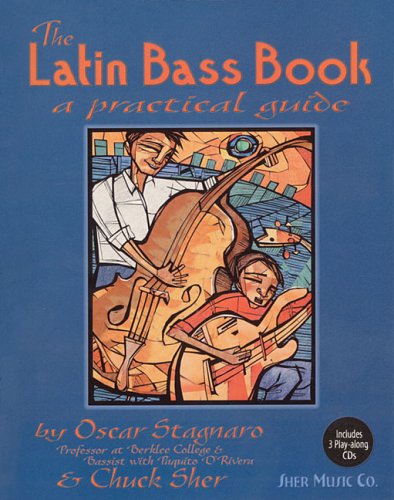
 This is a practical, comprehensive approach to learning Afro-Cuban, Brazilian and South American styles of bass playing, featuring 3 CDs of Berklee professor Oscar Stagnaro playing with three different world-class rhythm sections. The book consists mostly of transcriptions of every note Oscar plays on the accompanying CDs. Some amazing music, and logically progressing from simple to complex examples of each style.
Customer Review: What does one say?
This is a MASSIVE book (262 pages!) of latin bass in all it's various styles. We are not talking simple repetive patterns here either, we are talking from moderate to complex lines with excellent notation and a top notch CD set behind it. If you want to learn Latin Bass, you can start here, and stop here, as you won't find more and better probably anywhere else. Although it is not a Real Book, You can think of that kind of setup and variety.
Customer Review: Good intro to latin bass playing
This book is well thought, thorough and enjoyable. Comes with 3 CDs that stand alone on their own, if you don't mind having bass on one side and the rest of the band on the other. This arrangement allows you to pan the track and play along with the band, or focus on the bass line only. I googled some of the guys who play with Oscar in these CDs and they are first rate musicians with impressive resumes (try Rebeca Mauleón). It comes with no tab, but the first bass lines are simple enough so it wouldn't be a bad place to start reading, and once you understand the beats and where the bassline falls, you should be in a good position to read almost anything! The book takes you to a series of concepts that become more complex from track to track in a well thought way, so you build on your understanding of the subject. Probably the hardest part is to keep yourself from dancing while you play along to the CDs! A good purchase.
Ah, broken chords. The sound. The cascading pattern of chordal notes. It's beautiful. There's no doubt about it. And this technique is one of the easiest to learn. After all, all you need to do to create it is have a chord under your fingers and be able to "break it up."
What do I mean by break it up? You've probably heard of solid chords. This is when all tones are heard at once. For example, if I finger a C Major triad and play all three keys at once, I'm playing a solid chord. But, if I break this chord up into it's 3 notes and play them one at a time you get a broken chord.
Broken chords are used frequently in New Age piano music. There's something about playing notes of a chord in broken style that's very appealing. Maybe it's because it makes the piano sound fuller. Or it could be that it just sounds lovely.
Now, let's take a look at how we can easily create it.
In the lesson "Reflections in Water," we have 4 open position chords. These chords are ideal for "breaking up" because they are so wide-spaced. Over two octaves of notes lay under your finger tips. Once we finger this chord position we are able to play the broken-chord style. How? By simply letting your fingers play around with the note possibilities! And there are many of them.
When you listen to me play this piece, you'll notice that it's nothing to write home about. That is, I'm not after a "sophisticated" sound here. I'm just gently playing around with the notes and using the element of time to create a calm ambiance. And it works! The notes float out into the air and music is created. Not by planning or trying to come up with material but by following a few simple guidelines and letting go of the need to control the outcome.
Edward Weiss is a pianist/composer and webmaster of Quiescence Music's online piano lessons. He has been helping students learn how to play piano in the New Age style for over 14 years and works with students in private, in groups, and now over the internet. Visit http://www.quiescencemusic.com now and get a FREE piano lesson!
music on so you think you can dance
No comments:
Post a Comment