Saturday, June 28, 2008

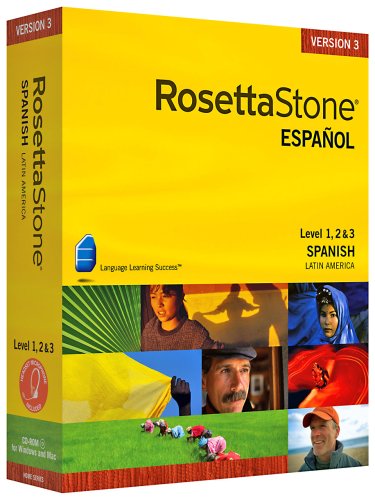
Rosetta Stone V3: Spanish (Latin America), Level 1, 2 & 3

Why is Rosetta Stone the world's No. 1 language-learning software? Because it works.

Escape the endless tedium of translation, memorization, and grammar drills. Get the language you want, the skills you need and the success you deserve by learning a new language naturally--the same way you learned your first language.

You learned your first language without translation.
You learned your first language easily and naturally by connecting words to objects and events around you. With Rosetta Stone, learn a new language the same way: using native speakers and thousands of real-life images to help you think in the new language from the very beginning. Studies show that learning exclusively in the new language, without translation as a crutch, is crucial.

The exclusive Dynamic Immersion method reinforces your natural language-learning skills with award-winning instructional technology. Identify your learning goals, then choose customized courses that take you there.


The complete immersion environment puts your native language-learning skills to work, eliminating your dependence on tedious translation and rote memorization.

Images Intuition

In Rosetta Stone you learn the meaning of new language from clear, real-life images.


In this activity you learn colors.

You advance using language you've learned and clues from new images. That's your intuition at work.


Now that you know colors, you can easily grasp the meaning of the new words...

Interactivity Instruction

Throughout Rosetta Stone, you constantly interact with the program to confirm your intuition.


...and then check what you've learned.

From beginning to end you build systematically toward your language-learning goals, for the most effective and enjoyable instruction anywhere.


And finally, you get the fun of trying your new language in a real-life simulation. Speech recognition shows you exactly how you're doing.

The timeless immersion method, along with research-based techniques and new technologies, make Rosetta Stone the clear solution to your language-learning needs.

What will you be able to do?

Understand everyday language.
Through Rosetta Stone's proficiency-based listening and reading activities, you'll learn quickly.

Pronounce words correctly.
After practicing with Rosetta Stone's speech recognition and analysis tools, pronunciation will come easily.

Speak without a script.
Contextual Formation makes sure you have the confidence and cues you need to get the words out on the spot.

Spell and write accurately.
You'll build gradually from letters to words and sentences.

Engage in real-life conversations.
With Milestone activities, gain confidence using speech alone in simulated situations.

Retain what you learn.
The unique Adaptive Recall reinforces language so it sticks with you in the real world.
Customer Review: Rosetta Stone V3-Spanish (Latin America) Level 1,2,3
I purchased this for my college-aged daughter so that she could become proficient in Spanish. This has given her the practice she needs that the classroom (high school) did not.
Customer Review: Great Addition to School Learned Spanish
I took 17 hours of Spanish during my undergraduate degree, but could not speak Spanish. I could read Spanish, but I could not understand it when spoken. Rosetta Stone takes a different approach to teaching Spanish than my university. It has made understanding and speaking Spanish within my reach. I had a strong vocabulary base, but Rosetta Stone has helped me to be able to speak and use this vocabulary in everyday conversation. This is a great complement to any Spanish curriculum. It is a wonderful option for those who couldn't learn Spanish "the old fashion way."


The city of Paris has so much to offer travelers it's difficult to know where to begin. Although the wide variety of youth hostels in Paris mean that it is possible to experience each section of Paris on its merits and, even if only for a fleeting few days, as a resident.

River Seine

With a supremely efficient and metro service that's cheap, regular and comfortable there's little point in walking. However, to see Paris in this way would be to miss out on its unique atmosphere and attention-grabbing sights and for this reason, a walk along the River Seine is the perfect place to start.

Although it's advisable to take a map anyway, many of the city's most renowned landmarks, such as the Eiffel Tower and the Notre Dame Cathedral jut out of the city around them with an unmissable and indescribably grand distinction.

Latin Quarter

The Latin Quarter is not only home to many of the best youth hostels in Paris, but also offers some of the best and most finance-friendly nightlife on offer in the city. Originally so-called because of its predominance of Latin-speaking students, it has fast become the social and shopping hub of Parisian students and budget travelers.

The street market along the Rue Mouffetard is one such location, which by day offers food and drink stuffs as well the occasional souvenir. By night however, the restaurants and cafes clamor for custom by offering cheap deals on already superbly priced and generally high-quality food that is an attraction of Paris all of its own.

Nightlife

Clubs and bars in Paris are rife with activity in the evenings, with the Latin Quarter and the famed Moulin Rouge offering a wide range of themes to appeal to a variety of tastes.

The nightlife proper tends to take off quite late in the evening, generally to accommodate the late dinner that characterizes Parisian habit. However, be warned that the Metro only runs until 1:30 AM.

Although cabs are readily available, for the budget traveler keen on sampling the nightlife on a regular basis, it is often more advisable to select youth hostels in Paris located close to the clubs and bars.

Before settling down and becoming a copywriter for HostelBookers, Ben Cooper stayed in some youth hostels in Paris

music on so you think you can dance

The Collected Poems of Octavio Paz, 1957-1987: Bilingual Edition

tr Weinberger, w/Bishop, Blackburn, Levertov et al
Customer Review: Collected Poems of Octavio Paz
This is an excellent edition of the collected poems of Octavio Paz, with English translations facing the Spanish originals. I purchased this as a gift for my Spanish teacher and she was delighted! My favorites are his poems written when he served as a Mexican diplomat in India and Japan. His sensitive mind absorbed the nuances of place and religion, which are recreated for us in the poems. His efforts at haiku en espagnol are enlightening, pun intended.
Customer Review: excellent poetry
I bought this book after reading an excerpt of one of Paz's poems at a camp. I didn't know what poem it was from, so I bought the book and scoured it until I found the poem. It was Brotherhood. The poetry is beautiful and moving. It is the type of poetry you can read and enjoy no matter if you understand what it is saying, the writing is that beautiful


Among our friends and clients at Lingoport, we regularly see ranges of confusion, to complete lack of awareness of what Unicode is. So for the less- or under-informed, perhaps this article will help. The advent of Unicode is a key underpinning for global software applications and websites so that they can support worldwide language scripts. So it's a very important standard to be aware of, whether you're in localization, an engineer or a business manager.

Unicode Growth

Firstly, Unicode is a character set standard used for displaying and processing language data in computer applications. The Unicode character set is the entire world's set of characters, including letters, numbers, currencies, symbols and the like, supporting a number of character encodings to make that all happen. Before your eyes glaze over, let me explain what character encoding means. You have to remember that for a computer, all information is represented in zeros and ones (i.e. binary values). So if you think of the letter A in the ASCII standard of zeros and ones it would look like this: 1000001. That is, a 1 then five zeros and a 1 to make a total of 7 bits. This binary representation for A is called A's code point, and this mapping of zeros and ones to characters is called the character encoding. In the early days of computing, unless you did something very special, ASCII (7 bits per character) was how your data got managed. The problem is that ASCII doesn't leave you enough zeros and ones to represent extended characters, like accents and characters specific to non-English alphabets, such as you find in European languages. You certainly can't support the complex characters that make up Chinese, Korean and Japanese languages. These languages require 8-bit (single-byte) or 16-bit (double-byte) character encodings. One important note on all of these single- and double-byte encodings is that they are a superset of 7-bit ASCII encoding, which means that English code points will always be the same regardless the encoding.

The Bad Old Days

In the early computing days, specific character single- and double-byte encodings were developed to support various languages. That was very bad, as it meant that software developers needed to build a version of their application for every language they wanted to support that used a different encoding. You'd have the Japanese version, the Western European language version, the English-only version and so on. You'd end up with a hoard of individual software code bases, each needing their own testing, updating and ongoing maintenance and support, which is very expensive, and pretty near impossible for businesses to realistically support without serious digressions among the various language versions over time. You don't see this problem very often for newly developed applications, but there are plenty of holdovers. We see it typically when a new client has turned over their source code to a particular country partner or marketing agent which was responsible for adapting the code to multiple languages. The worst case I saw was in 2004 when a particular client, who I will leave unmentioned, had a legacy product with 18 separate language versions and had no real idea any longer the level of functionality that varied from language to language. That's no way to grow a corporate empire!

ISO Latin

A single-byte character set that we often see in applications is ISO Latin 1, which is represented in various encoding standards such as ISO-8859-1 for UNIX, Windows-1252 for Windows and MacRoman on guess what platform. This character set supports characters used in Western European languages such as French, Spanish, German, and U.K. English. Since each character requires only a single byte, this character set provides support for multiple languages, while avoiding the work required to support either Unicode or a double-byte encoding. Trouble is that still leaves out much of the world. For example, to support Eastern European languages you need to use a different character set, often referred to as Latin 2, which provides the characters that are uniquely needed for these languages. There are also separate character sets for Baltic languages, Turkish, Arabic, Hebrew, and on and on. When having to internationalize software for the first time, sometimes companies will start with just supporting ISO Latin 1 if it meets their immediate marketing requirements and deal with the more extensive work of supporting other languages later. The reason is that it's likely these software applications will need major reworking of the encoding support in their database and functions, methods and classes within their source code to go beyond ISO Latin support, which means more time and more money - often cascading into later releases and foregone revenues. However, if the software company has truly global ambitions, they will need to take that plunge and provide Unicode support. I'll argue that if companies are supporting global customers, and even not doing a bit of translation/localization for the interface, they still need to support Unicode so they can provide processing of their customer's global data.

Unicode

We come back to Unicode, which as we mentioned above, is a character set created to enable support of any written language worldwide. Now you might find a language or two lacking Unicode support for its script but that is becoming extremely isolated. For instance, currently Javanese, Loma, and Tai Viet are among scripts not yet supported. Arcane until you need them I suppose. I remember a few years ago when we were developing a multi-lingual site which needed support for Khmer and Armenian, and we were thankful that Unicode had just added their support a few months prior. If you have a marketing requirement for your software to support Japanese or Chinese, think Unicode. That's because you will need to move to a double-byte encoding at the very least, and as soon as you go through the trouble to do that, you might as well support Unicode and get the added benefit of support for all languages.

UTF-8

Once you've chosen to support Unicode, you must decide on the specific character encoding you want to use, which will be dependent on the application requirements and technologies. UTF-8 is one of the commonly used character encodings defined within the Unicode Standard, which uses a single byte for each character unless it needs more, in which case it can expand up to 4 bytes. People sometimes refer to this as a variable-width encoding since the width of the character in bytes varies depending upon the character. The advantage of this character encoding is that all English (ASCII) characters will remain as single-bytes, saving data space. This is especially desirable for web content, since the underlying HTML markup will remain in single-byte ASCII. In general, UNIX platforms are optimized for UTF-8 character encoding. Concerning databases, where large amounts of application data are integral to the application, a developer may choose a UTF-8 encoding to save space if most of the data in the database does not need translation and so can remain in English (which requires only a single byte in UTF-8 encoding). Note that some databases will not support UTF-8, specifically Microsoft's SQL Server.

UTF-16

UTF-16 is another widely adopted encoding within the Unicode standard. It assigns two bytes for each character whether you need it or not. So the letter A is 00000000 01000001 or 9 zeros, a one, followed by 5 zeros and a one. If more than 2 bytes are needed for a character, four bytes can be combined, however you must adapt your software to be capable of handling this four-byte combination. Java and .Net internally process strings (text and messages) as UTF-16.

For many applications, you can actually support multiple Unicode encodings so that for example your data is stored in your database as UTF-8 but is handled within your code as UTF-16, or vice versa. There are various reasons to do this, such as software limitations (different software components supporting different Unicode encodings), storage or performance advantages, etc.. But whether that's a good idea is one of those "it depends" kinds of questions. Implementing can be tricky and clients pay us good money to solve this.

Microsoft's SQL Server is a bit of a special case, in that it supports UCS-2, which is like UTF-16 but without the 4-byte characters (only the 16-bit characters are supported).

GB 18030

There's also a special-case character set when it comes to engineering for software intended for sale in China (PRC), which is required by the Chinese Government. This character set is GB 18030, and it is actually a superset of Unicode, supporting both simplified and traditional Chinese. Similarly to UTF-16, GB 18030 character encoding allows 4 bytes per character to support characters beyond Unicode's "basic" (16-bit) range, and in practice supporting UTF-16 (or UTF-8) is considered an acceptable approach to supporting GB 18030 (the UCS-2 encoding just mentioned is not, however).

Now all of this considered, a converse question might be, what happens when you try to make your application support complex scripts that need Unicode, and the support isn't there? Depending upon your system, you get anything from garbled and meaningless gibberish where data or messages become corrupted characters or weird square boxes, or the application crashes forcing a restart. Not good.

If your application supports Unicode, you are ready to take on the world.

Adam Asnes founded Lingoport in 2001 after seeing firsthand that the niche for software globalization engineering products and services was underserved in the localization industry. As Lingoport's President and CEO, he focuses on sales and marketing alliances while maintaining oversight of the company's internationalization services engineering and Globalyzer product development. Adam is a frequent speaker and columnist on globalization technology as it affects businesses expanding their worldwide reach. http://www.lingoport.com

latin music artist

Rebelde Barbie Doll Assortment

Rebelde Barbie Doll Assortment Introducing three dolls from the characters of the popular Rebelde telenovela and hot pop-rock music group RBD: Roberta, Mia and Lupita! These chart-topping 'tween pop and soap-opera stars come dressed in their school-girl uniforms of red blazer, tie and tiered denim skirt, each with the exuberance of their own personal style.


i.e. vs. e.g.

Use i.e. , to re-name, restate, or to clarify, as in, "He fell out of the window, i.e., down." This is an abbreviated Latin term (id est) that roughly translates as, "which is to say..." or "meaning..."

Use e.g., to provide examples, as in, "He liked falling from heights, e.g., out of windows, from airplanes, off of ladders." This is an abbreviated Latin term (exempli gratia) that translates as "For example..."

[And don't forget the comma after either one.]

Data is plural

Example: "The data are complete; we conclude that falling is dangerous." [We hear data used as a singular noun so often that the mistake seems right, but it isn't.]

Like vs. Such as

Use like to show similarities, as in, "He was falling like a rotten tomato that missed the stage."

Use such as to provide examples, as in, "Everything falls at times, such as tomatoes and bodies from windows." [Not: "Everything falls at times, like tomatoes and bodies from windows." Another correct way to say this is "Everything falls at times, e.g., tomatoes and bodies from windows."]

Everyone is singular

Example: "Everyone needs to jump out of his window." [Not: "Everyone needs to jump out of their window." You could use "his or her" to be politically correct.]

Comprise vs. Compose

Comprise means to gather multiple parts into a single whole. A good synonym is assemble. For example, "The band comprised [assembled] many different players." [Not: "The band was comprised of many different players."] Here, you have a whole and are describing its parts.

Compose means to make a whole by putting together multiple parts. A good synonym is create. For example, "The band was composed [created] of many different players." Here, you have the parts and are showing how they are put together to make a whole.

The difference is subtle, but what you need to consider is whether you are emphasizing the whole (the band) or the parts (the members of the band).

Staff is not a person

Use staff to refer to the entire group of employees and colleagues, and it is singular (the plural is staffs). A good synonym is team. For example: "The staff [team] is upset with the pay raise."

Use staff person or staff member to refer to an individual person on the staff. So, you would write, "Six staff members are not coming to work today." This refers to the individual people. If you want to refer to the entire staff at once, you would write, "The staff is not coming to work today."

David Bowman is the Owner and Chief Editor of Precise Edit, a comprehensive editing, proofreading, and document analysis service for authors, students, and businesses. Precise Edit also offers a variety of other services, such as translation, transcription, and website development. Click here for more information about Precise Edit's services.

dance music charts