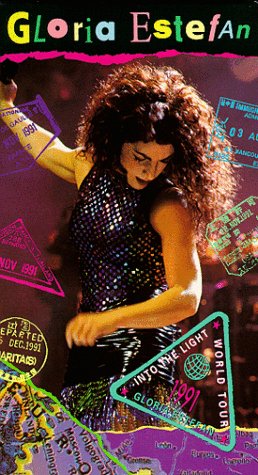
 Captured during a two-night stand at a Dutch arena, this 100-minute concert special documents Gloria Estefan's lavish 1991 world tour, which underscored the Cuban-American singer's graduation from acclaim as a dance-floor diva to the ranks of female pop superstars. At its best, Into the Light World Tour displays the relentless energy, personal warmth, and crack musicianship that Estefan and her husband, producer, and principal collaborator, Emilio Estefan Jr., had evolved through her old band, the Miami Sound Machine, and taken uptown through her solo career. When the star and her band kick into high gear, percussion simmering and horns blazing in taut, deftly arranged choruses, the propulsive lure of salsa is hard to resist.
Technically, Estefan is a singer with a supple tone but modest range, hardly suggesting the caliber expected of a bona fide diva. Neither does her small, compact frame suggest a dancer's physique, despite the production's reliance on extended dance sequences. Yet she makes the most with what she has, harnessing formidable physical energy and transmitting considerable warmth to her audience. Her material, including both Miami Sound Machine hits and subsequent solo signatures, works best when staying closest to her roots, riding the giddy syncopations of uptempo Latin rhythms, or plying the lambent emotions of traditional ballads. Her exhortations to dance--"Get on Your Feet," "Conga," and "Rhythm Is Gonna Get You" being the inevitable faves--work handily with an ecstatic audience.
More grizzled viewers should be forewarned that this, like most recent concert films, isn't purely documentary--apart from backstage sequences that duly flatter the star, the live sound has been liberally sweetened during post-concert production. --Sam Sutherland
Customer Review: A great concert
I never actually saw this video. I was at the concert. The concert was awesome, so if this video does a decent job of capturing it, then it should be great too.
Customer Review: Gloria is the best and so are her concerts
Gloria is the best singer ever. On stage she's a divette. She's the best and so are her shows. The way she sings live is great, and so is her dancing. The band is great too. They know how to play and everybody goes wild in the audience!!!!!!!Always!!!!! I love her with all my heart and soul, 4 ever.....
Few songs that break the rules of pop songwriting ever achieve mainstream success. Deviate from the predictable verse/chorus structure in 4/4 time arranged for a basic grouping of guitar/keyboards, bass and drums, and you can pretty much guarantee being marginalized. During a 20-year period from roughly 1965-1985, however - a period that witnessed a flowering of musical creativity and widespread openness to experimentation - it was possible to break the rules and have a hit record. Here are ten unlikely hits from that period.
Good Vibrations - Beach Boys - 1966, #1
Brian Wilson spent six months and an unheard of $50,000 perfecting this pop masterpiece. While it starts out with the usual verse/chorus alternation, it moves into a contrasting section that could be a bridge except that it moves on to something yet different. The music quiets down to a hush - highly unusual for the middle of an uptempo song - before the voices launch back into the chorus. Rather than fade out on the chorus at this point (the standard formula), a completely new section intercedes before the outer space theremin from the chorus returns minus the vocals to lead the fade-out.
White Rabbit - Jefferson Airplane - 1967, #8
This quintessential example of pyschedelia is built on an unusual AAB structure. In the first half, the melody follows a folk song pattern: rather than a chorus, the two verses each conclude with a melodic tag. The song then breaks free from this structured section and moves into something that feels more improvisatory. The melody rises higher as the music intensifies and climaxes with the final phrase repeated twice.
Suite Judy Blue Eyes - Crosby, Stills & Nash - 1969, #21
True to its name, this is a mini-suite of four contrasting sections: ABCD. There are no choruses, only a changing sequence of verses. After slowing in the B section, the rhythm picks up in the C section. The sequence of verses becomes condensed in section D, propelling the music to its climax.
Black Dog - Led Zeppelin - 1969, #15
A song in which the music keeps stopping and starting breaks the rule of continuity, but there is a play between symmetry and asymmetry in the structure of "Black Dog" that is both surprising and satisfying. The structure is: A (verse three times) / B (instrumental) / A (verse two times plus "ah ah" melody) / C (contrasting bridge). Then the entire structure is repeated.
Uncle Albert/Admiral Halsey - Paul McCartney & Wings - 1971, #1
Two disparate songs were combined to create this study in contrasts. The opening, slower "Uncle Albert" song is comprised of three verses, two sung and one spoken. The second song, "Admiral Halsey," by contrast, is uptempo and uses a verse/chorus structure. But McCartney further plays with our expectations by putting the chorus first, and instead of a second verse he goes into a third contrasting section in an even faster tempo ("little little be a gypsy"), before returning to the chorus.
Living in the Past - Jethro Tull - recorded 1969 but released 1972, #11
Money - Pink Floyd - 1973, #13
These two songs used unorthodox time signatures: 5/4 and 7/4 respectively (Apparently the irregular beat did not interfere with general public's ability to enjoy the music). The clever use of cash register sounds to set the rhythm in "Money" is also an unusual introduction for a song.
Bohemian Rhapsody - Queen - 1975, #2
The blending of a soulful ballad, a rousing rock-out section, and a tongue-in-cheek opera make this virtuosic song an unlikely hit, but it has become one of the most enduring songs of the 20th century. Probably no other popular song has captured the essence of the surreal so well.
O Superman - Laurie Anderson - 1981, #2 (U.K.)
Everything about this song, from its half sung/half spoken lyrics to its vocoder vocals to its minimalist arrangement and rhythmic pulse built from repetitions of the sound "ha" cry out "anti-pop." Yet its eccentricity was its charm. Groups like Kraftwerk, the B52s and Devo were also having success with eccentric, anti-pop music during this period.
When Doves Cry - Prince - 1984, #1
Prince had to fight hard to stand his ground against Warner executives who could not imagine that a dance song without a bass part could be successful. But the brilliant omission of the bass line heightens the plangent, high register cries of his voice at the end of each chorus. With the minimal arrangement - drums, vocals and simple keyboard motive (augmented by strings in the final chorus) - Prince distills the music into its most basic elements: the percussive rhythm and the expressive lament of the voice.
While many artists continue to write music that isn't a slave to pop song format, such songs have largely vanished from the hit charts since the mid 1980s. Musically, the public has become much more conventional, shifting its focus from musicality to image and celebrity, which increases the pressure on artists to stick to the formula. Perhaps we'll someday see a resurgence of mainstream music that isn't afraid to break the rules.
More music articles at Song of Fire (obergh.net/songoffire)
latin music artist
No comments:
Post a Comment