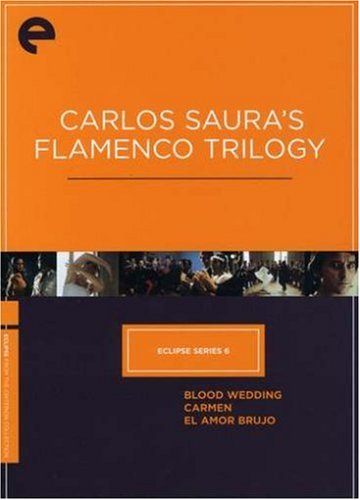
 One of Spanish cinema's great auteurs, Carlos Saura brought international audiences closer to the art of his country's dance than any other filmmaker, before or since. In his Flamenco Trilogy-Blood Wedding, Carmen, and El amor brujo-Saura merged his passion for music with his ongoing exploration of Spanish national identity. All starring and choreographed by legendary dancer Antonio Gades, the films feature thrilling physicality and electrifying cinematography and editing-colorful paeans to bodies in motion as well as to the cinema that so eloquently, and artfully, captured them.
Customer Review: Fantastico!
If you want a sweet taste of flamenco - this is a perfect set. Starting w/Blood Wedding - progressing to Carmen - and finishing w/El Amor Brujo. Fantastico!
Customer Review: Brilliance
My love of flamenco music was born when I heard Carlos Montaya playing when I was about 25 years old. I am now 73 years old and when I hear flamenco it is through my heart not my ears, I watched this dvd Eclipse Series 6 Carlos Saura's Flamenco on my 107 " plasm tv, it was breathtaking, such brilliance and beauty, watching it over and over again it moves me every time.
The idea of dancing horses may seem both novel and strange to some people. Many animals "dance" especially as part of the courtship ritual. Just like with us there can be a very strong link between dance and sexuality. At shows such events for our canine friends are becoming common place. Dogs while entertaining and enthusiastic performers lack both the grace and sophistication of the dancing horse.
The exponents par excellence of this equestrian art are the horses of Andalusia. Along with the Arab and Thoroughbred they are the aristocrats of the horse world. Roman writers noted the excellent quality of the Spanish native stock. The Moors then cross bred them with their own Arab and Berber breeds which were later to influence most American and European breeds of horse.
The Lippizaners of the Spanish Riding School in Vienna are direct descendants of the Andalusian horse.
This horse is prized for its elegance, proud head carriage, short arched neck, silky flowing mane, compact body and harmonious proportions. It is customary in Spain to clip the mare's manes. Only the stallions are allowed to keep their long flowing manes. Nearly half of all Andalusian horses are either grey or white. The remainder are bay or black. Chestnuts or piebalds are excluded from the stud book.
These horses are gifted with great intelligence combined with an affectionate and gentle nature.It is considered to be the Dressage and Carriage horse par excellence.
The Andalusian marshes in particular provide the animals with nutritious pastures.This fact and the excellent climate contribute to the successful breeding of this horse.
The dancing horse combines sport with aesthetics. Dance training begins when the horse is still young though physically strong and mature. It is essential that the horse have a certain configuration and the right temperament. The movements they are taught are an extension of the natural playful frolicking of the young horse, and the "showing off" of the stallions as they try to impress a possible mate.
During training the horse must be relaxed at all times. The movements to be learned are broken down into a series of steps. The trainer does not compel the horse to do anything it does not want to do. It's efforts are always rewarded. One characteristic natural movement of the Andalusian horse is to throw it's forelegs in an outward arc before putting its hooves to the ground. This movement is very "balletic". In Spain this action is greatly appreciated whereas in England it is frowned upon.
One of the principle exponents of this art form in Spain is the Royal Andalusian School of Equestrian Art in Jerez de la Frontera. the school occupies an impressive villa. It is here that the pure breed Andalusian thoroughbreds learn their high precision ballets.
The school regularly holds shows for the general public. "How the Andalusian Horses Dance" combines choreography, classical flamenco and the Andalusian equestrian tradition into a breathtaking show. The equestrian ballet is accompanied by traditional Spanish music with the riders wearing eighteenth century costumes.
There is a demonstration of Doma Vaquera the "cowboy" type of dressage of a practical nature used in the countryside to herd cattle. The show includes a performance of classical dressage with pieces with names such as "The Foals", "Two Step" and "Three Step".
Another section includes carriage driving, and hand control where the horse obeys instructions from its rider on the ground. The highlight of the show is the Carousel where a group of horses and their riders, carry out synchronized advanced equitation exercises in the ring.
It really is a beautiful sight to see the young women on foot dancing Flamenco with their horses as their partners. The horse is directed and controlled by his rider who remains on foot. There is a wonderful interaction between horse and humans.
Don't miss an opportunity to see the dancing horses of Andalusia if you have the chance.
Dzagbe Cudjoe is a Dance and Movement Therapist, Intuitive Counselor, Healer and Ethnologist with a keen interest in promoting Dance as a means of achieving Mind-Body-and-Spirit integration... She is the author of the e-manual "Dance to Health -Help Your Special Needs Child Through Inspirational Dance". available at Dance to Health
latin jazz music
No comments:
Post a Comment