Saturday, July 19, 2008

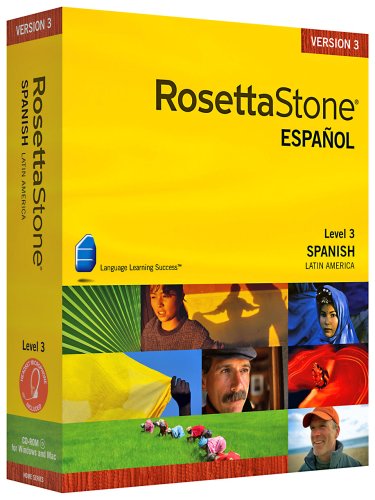
Rosetta Stone V3: Spanish (Latin America), Level 3

Why is Rosetta Stone the world's No. 1 language-learning software? Because it works.

Escape the endless tedium of translation, memorization, and grammar drills. Get the language you want, the skills you need and the success you deserve by learning a new language naturally--the same way you learned your first language.


The complete immersion environment puts your native language-learning skills to work, eliminating your dependence on tedious translation and rote memorization.

Images Intuition

In Rosetta Stone you learn the meaning of new language from clear, real-life images.


In this activity you learn colors.

You advance using language you've learned and clues from new images. That's your intuition at work.


Now that you know colors, you can easily grasp the meaning of the new words...

Interactivity Instruction

Throughout Rosetta Stone, you constantly interact with the program to confirm your intuition.


...and then check what you've learned.

From beginning to end you build systematically toward your language-learning goals, for the most effective and enjoyable instruction anywhere.


And finally, you get the fun of trying your new language in a real-life simulation. Speech recognition shows you exactly how you're doing.

You learned your first language without translation.
You learned your first language easily and naturally by connecting words to objects and events around you. With Rosetta Stone, learn a new language the same way: using native speakers and thousands of real-life images to help you think in the new language from the very beginning. Studies show that learning exclusively in the new language, without translation as a crutch, is crucial.

The exclusive Dynamic Immersion method reinforces your natural language-learning skills with award-winning instructional technology. Identify your learning goals, then choose customized courses that take you there.

The timeless immersion method, along with research-based techniques and new technologies, make Rosetta Stone the clear solution to your language-learning needs.

What will you be able to do?

Understand everyday language.
Through Rosetta Stone's proficiency-based listening and reading activities, you'll learn quickly.

Pronounce words correctly.
After practicing with Rosetta Stone's speech recognition and analysis tools, pronunciation will come easily.

Speak without a script.
Contextual Formation makes sure you have the confidence and cues you need to get the words out on the spot.

Spell and write accurately.
You'll build gradually from letters to words and sentences.

Engage in real-life conversations.
With Milestone activities, gain confidence using speech alone in simulated situations.

Retain what you learn.
The unique Adaptive Recall reinforces language so it sticks with you in the real world.
Customer Review: great system
I am now on the 3rd and final level of Rosetta Stone's Spanish (Latin America). I have been very impressed with the series. I do also use Pimsleur Spanish CDs in my car to supplement my learning. I'd recommend both to anyone interested in learning any language.
Customer Review: Installation challenges
This version is sold as Vista compatible, however installation was not straight forward with Vista Ultimate as operating system. Once installed there is an error message as the file framedynos.dll is not found. We needed to copy it into the program directory. The activation program does not work with Vista, we needed to disconnect the PC from the internet and activate via phone. Neither of these two problems was listed in the manual. The good thing was that the phone service was available even late in the night. Once these two hurdles were overcome the program seems to be working well.


New! Avoid costly lapses in judgment and many mistakes when you determine how to play guitar using Jamorama.

The Jamorama software has so many reasons for the modern guitarist to buy it-I mean, just think about how you can get a head start on learning patterns, chords, scales and more! Study the guitar at your own pace-no more embarrassment from your guitar instructor b/c you didn't rehearse your guitar scales for the week!

Who requires all that hard work anyway?

You don't need the hassle from those guys because the guitar software from Jamorama takes all that stress of studying guitar out of the picture-virtually completely. I think back when I was starting to learn how to play guitar...

I hated my guitar lessons-really!

I had to go to my dang lessons every week, and it seemed that if I didn't know my scales right or have the right amount of perfection each time, my guitar instructor would be upset at me.

But, I needed to discover how to play songs!

I didn't know that the scales were really a part of that- I felt like Karate Kid, doing all those chores. The only difference was, my guitar instructor never really explained that these melodic scales would kick open many doors- I just felt eternal frustration and disappointment inside.

I wasn't getting to the meat- I was chewing on mush. bring in on the rock, I thought!

The good news is-

Jamorama Keeps You Inspired and Excited About Taking Guitar

The secret to getting fantastic guitar skills, especially determining your worth with an on-line program, is that you need to remain motivated and inspired. How do you do this on-line?

Well, for one thing, you have to find a course that fits you, that goes at a quick or slow pace of learning, whichever you prefer. Plus, with the Jamorama guitar course, it's all on-line. Nothing to really carry around, no books or videos, just all of your stuff on your desktop or on-line- just you and your guitar and your computer. There's no one to make fun of you or let you down!

You Get 148 Guitar preparation Courses In The Jamorama Guitar Software

So, with Jamorama, no annoying guitar instructor or 'guru' that you feel like you have to impress or you aren't 'studying your instrument right' or something like that. You get to use Jamorama in the freedom of your own base, at your own pace- that is a huge gain.

Also, you get access, pretty much instantly, to 148 guitar education videos and guitar courses! This is just awesome- pretty much any thing you desire to acquire out of your guitar playing-any music style, famous guitarist style, or theory is at your fingertips. Recite and practice your guitar while watching these guitar preparation and style videos, all at your own pace, without worrying about pleasing anyone!

Forget Asking About Guitar Scales and Chords: These Is A Guitar Forum For That!

Forget having to ask mortifying questions to your guitar instructor or try to gleam the knowledge from books at Borders or DVD's from Netflix.

No Where Else Will You Get This Awesome Value From A Piece Of Guitar Software

Jamorama brings in lead guitar, acoustic, and other styles right into your household- at a fraction of guitar lesson cost! No where else will you find ways to learn patterns, discover and focus on how to use your guitar in ways you never dreamed possible. Do you require a new guitar? I'm sure the folks at the Jamorama guitar forum can help you out, even with those details!

Guitar Software Runs On Both Mac and PC Computers.

Jamorama also runs on Macs and PC's. This is great for Mac users, especially myself, because so much in the music industry, especially guitar education programs, seem to work for Mac or PC, but not both.

What if you have a PC system at your pad, and a Mac system at work or at your friend's house? Now you don't have to worry about that at all- just one more added gain while you are taking guitar with Jamorama. Now you don't have to worry about software formats or systems that won't let you study guitar.

So, whether you are needing to polish your chops and just go through the drill of learning guitar some, or, you desire to get a robust, fantastic, piece of stellar guitar preparation software, Jamorama is for you!

Lawton Chiles runs http://www.fenderguitarvault.com and highly recommends Fender Guitar Vault as the place to begin to learn about how to find some awesome guitar courses and sweet deals!

latin download
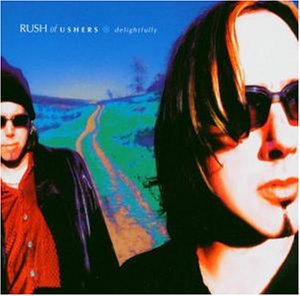
Delightfully

Los Angeles based band comprised of Daniel OBrien (vocalist/writer/producer) and Jeff Hull (drummer/writer/producer) who have been together now for over 9 years. The bands sound is a unique and hypnotic blend of Alternative Rock and Pop music a la Coldplay and U2. The songs are memorable and catchy, and the lyrics stem from Daniels own view of the world through dark, mysterious, and thought provoking glasses. Daniel was a staff writer for BMG and MCA and has had several songs released with other artists such as Heart, Susanna Hoffs (of The Bangles), and Terri Nunn (of Berlin). Jeff Hull has been writing music for EMI and is a prolific producer/writer and performer on drums and several other instruments. He has written and/or produced a number of songs for artists such as Holly Cole, Susanna Hoffs, Chynna Phillips and Jane Weidlen. Atenzia. 2005.


People dance for different reasons: for competition, to keep fit, meet new people, or simply to have a little fun. It's even become a way of visiting new countries, as shown by the growing popularity of dance holidays in Cuba, Brazil, Italy, Spain, Egypt and many other countries. But, whether they like to admit it or not, most people would in some way agree with the definition of dancing as "a vertical expression of a horizontal desire."

Let's face it, out of the list that I started with, all except the first have probably got some link to feeling sexy or meeting people to feel sexy with, and nowhere is this more apparent than in Cuba. Salsa, Mambo, Rumba, and Cha Cha Cha are some of the islands most prominent styles of dance, and each one is intimate, flirtatious and an important part of traditional courtship rituals in Cuba. Salsa may be the most well known of the island's dances, but is it the sexiest?

History of Dance in Cuba

For any visitor on holiday in Cuba, dance is inescapable. It is part of the culture, rooted in its mixed Spanish and African heritage. Most forms of dance in Cuba have evolved from Rumba, also know as Son. This older style came to Cuba in the 19th century, and ranges from the slow and formal Rumba Yambu to the fast and overtly sexual Rumba Guaguanco.The more modern styles of Mambo, Salsa and Cha Cha Cha were all born in the aftermath of the Communist revolution in the 1950s. It was a revolution in Cuba's dance halls as well as its politics, with the excitement of change fuelling passionate and inventive new forms of dance. Due to their common roots, many of the styles have similarities, such as the distinctive Latin hip movement and close footwork. Salsa and Mambo are based on a "quick-quick-slow" rhythm, while the Cha Cha Cha has a quick three step in place of the slow step.

Learning the moves

Whether you are drawn to Mambo or Cha Cha Cha, Rumba or Salsa, a dance holiday in Cuba can provide the best introduction to your style of choice. The capital, Havana, features the best clubs for Salsa in Cuba, while the northern city of Matanzas was one of the birthplaces of Rumba. A dance holiday in Cuba certainly isn't the only way of learning your first Cuban dance moves, and it can certainly help to have a handle on the basics before splashing out on a trip abroad. But a taste of Latin American culture can be vital to really get into these dances, and a holiday in Cuba, Salsa oriented or otherwise, can only help you get into the swing of things.

Dirty Dancing

When it comes to judging which of the Cuban dance styles is the sexiest I have to admit to a certain bias; I fell in love with the Salsa dance on holiday in Cuba a long time ago. The island has shared its popular coffee, cigars and rum with the world, but when it comes to rating the finest export of Cuba, the Salsa dance should rank high on anyone's list. It's now evolved into many different styles and is practised by millions of amateurs and experts around the world, but the Salsa in Cuba remains the original and best.

Part of the appeal of the Cuban Salsa dance is its accessibility. Basic Salsa dancing is easy to learn, much more so than some of the other styles of dance in Cuba. Salsa is as tough a dance to master as any, but you can pick up the basic three step within a very short space of time; once you've got that, you're ready to go. You won't be winning competitions, but you'll be good enough to have fun and feel good on the dance floor.

Sexier than Son and more intimate than the Cha Cha Cha, it may not be the most beautiful or complicated dance in the world, but for me at least, Salsa in Cuba is still the sexiest dance of them all.

Emma Lelliott is the general manager of Captivating Cuba, an independent Cuba holiday specialist. With offices in Havana and the UK, Captivating Cuba can offer Cuban dance holidays holidays to Havana as well as expert advice on holidays to Varadero and Cayo Coco and lesser known resorts such as Jibacoa and Trinidad.

latin music video

Exitos en Video

Customer Review: Sound engeneer where are you?
The sound quality is horrendous, Mana make a lot of money off there fans I could not believe my ears. I end up play the cd and the videos Simultaneously to be happy. A live concert DVD is needed MANA.
Customer Review: Great Mexican rock band, great songs but...
When they made the DVD, there are some things they should have changed on it. If you're a Mana fan, you'll know all the songs. One live track, a cover of "El Rey" filmed in Montreux Switerland shows of Alex Gonzalez's drumming, something that doesn't come through on their studio tracks. As far as the videos themselves go, you see it going from something that is borderline public access video, to some embarrassing videos that are kind of humorous, to a more polished look towards the "Suenos Liquidos" videos, where it ends. Nothing from "Revolucion de Amor" or their song with Carlos Santana "Corazon Espinado" (which is on Carlos' "Supernatural" DVD) is included. Here's the complaints that I found more annoying than anything: the cover of Led Zeppelin's "Fool in the Rain", straight off of the "Econium" tribute video is them in the studio talking about recording the song. It either should be the full song or in the "extras". It's something that you wind up forwarding and gets annoying real fast. "Clavado En Un Bar" has 5 minutes of the "making of", yet you can't skip the making of, you have to forward it. Another one that belongs in the "extras". It's something that we should be able to enjoy with the TV on or off. The "in betweens" can get a little noisy at times but isn't a big deal. It's not in Surround Sound, but you can hear it playing in all the speakers. I'd like to see them revamp this one a little bit to make it more "DVD-friendly" and put out a live DVD which shows off how great they are in concert. Even if you don't understand Spanish, the music alone is good enough to enjoy...


It may come as a surprise for people who are not very involved in personalizing their mobile phones that choosing a ringtone can be a very tiresome and confusing task. Why? Because of the sheer amount of choices that a mobile phone user has to wade through in order to get the ringtone that he wants.

First of all, he has to consider what type of ringtone he wants to use. Does he want the old school monotone ringtone that was made popular by the early Nokia mobile phones? These are the ringtones that play melodies one note after the other. He may also choose a polyphonic ringtone, which is a more melodic choice compared to the drab monotone ringtone. Of course, if his mobile phone is capable of supporting it (which most new models can) he can opt to use music ringtones, which are actual pre-recorded pieces of the actual music. This is the best available ringtone type out there and is the acknowledged favorite, especially among people who really love music.

Having gone through the ringtone types, the choice just gets wider. There are so many companies online that are specializing in bringing ringtones to your mobile phone that each one would offer unique ringtones that would catch the attention of consumers and hopefully entice them to buy the ringtone. But aside from the many companies out there, a mobile phone user has to choose from so many available genres of ringtones available, especially those for music ringtones. The choices are so varied and so many that one would be hard pressed to choose which ones a mobile phone user would like to install on his phone as a ringtone.

Some of the most popular ringtone genres are:

Funny ringtones - These are ringtones with an obvious comedy bent. These could be hilarious one liners, missives or dialogues. It is not uncommon to hear funny ringtones that try to parody certain scenes in famous movies or TV shows or maybe even funny sounds.

Bollywood ringtones - These ringtones are all about the magic that is brought by Indian films. Indian films are a strange and wonderful film genre. The formula that Indian films follow are quite different. Whether it be drama, comedy or even action, a movie will not be complete without song and dance numbers. Most Indians believe that a movie without this element makes it incomplete. These fun-filled Bollywood songs are now considered as great ringtones because it exudes the tongue-in-cheek fun and bombastic romp of those crazy Indian films.

Music ringtones - Music is by far the most popular ringtone genre that mobile phone users prefer. Every single person has a particular song or type of music that he loves and these preferences can act as great ringtones. Of course, music ringtones have as many genres as there are different types of music out there. Whether you like pop, rock, reggae, or even classical,, there most likely be a ringtone that you can download or buy online. Based on a recent study, the most popular genre that mobile phone users choose as ringtones are music in the rap/hip hop category.

Philip Nicosia is the webmaster of GetMeRingtones, a site specialising in the different genres of ringtones, including polyphonic ringtones, and MP3 ringtones.

80's dance music

DEATH CAB FOR CUTIE - DOGGIES - T-SHIRT


Gharana essentially means a school of thought, or a school of music, that follows a particular style perfected over the years by rigorous practice and enhanced by coming generations that combine contemporary styles and incorporate new ideas. Gharana literally means family tradition, members of a family of musicians establishing their own unique musical discipline consistently over three or more generations. It is difficult to give an exact date when this system came into being. Ithawa gharana has evolved over seven generations of some of the finest sitar players of India. Shujaat Khan is seventh in this unbroken chain of sitar virtuosi from Ithawa gharana and is considered to be the torch bearer for the future of this school of music. With Shujaat Khan in concert today, it would be appropriate to bring forth some of the hidden facts about the history and evolution of this style of music.

Ithawa gharana in its present form owes its existence, its popularity and its distinctive style of sitar playing to Shujaat Khans father, the legendary musician Ustad Vilayat Khan. But for him, the gayaki ang or vocal style in instrumental music, which is the hall mark of this gharana, would neither have existed nor would have flourished. To talk about Ithawa gharana of recent years is to talk about Vilayat Khan and his early period of musical training, his original thoughts about bringing gayaki in instrumental playing, his improvisations and changes made to the structure of sitar to accommodate the continuity of sound or to imitate vocals in sitar playing. It is believed that only after Vilayat Khans tantalizing performance that won the hearts of the listeners, critics and musicians alike, at the 1943 Vikram Samaroh music conference in Bombay, instrumental music earned a wider acceptance in the main stream classical music.

Born in 1928 in Gauripur, East Bengal, Vilayat Khan entered the world of music at an early age of four and gave his first performance when he was eight. He also made his first recording at the same age. Vilayat Khan hails from an impressive family of musicians. His great grand father Ustad Sahabdat Khan gave todays surbahar, the bass version of the sitar and a very difficult instrument to master, its present tonal and structural form. At the early age of ten Vilayat Khan lost his first guru, his father Ustad Inayat Khan, a leading instrumentalist of his days. Thereafter he moved with his mother to the state of Nahan near Delhi to learn music from his maternal grand father Ustad Bande Hasan Khan, who was the court musician of the state. During 40s and 50s there still was Inayat Khans influence in Vilayat Khans playing. Tantrakari was still very prominent. The right hand which is considered as the main subject of instrumental playing for string instruments was still distintly dominant. Tantrakari had been taken to great heights by earlier generations but now was the time to give new direction to instrumental music. It is believed that human voice is the sublime epitome of expression and all other sounds are subordinates used only for enhancing and ornamenting the vocal music. In his quest to achieve vocal continuity in the sound of sitar, Vilayat Khan introduced the gayaki ang in instrumental music during the early 60s.

Khayal ras, a vocal music style with imaginative use of lyrics, began to emerge in instrumental music with Vilayat Khans introspective vision and vivid imagination. The tone of sitar was now changed. The right hand remained at its place but there were significant advancements in the left hand. The pancham of kharaj was now replaced with a steel gandhar (this change helps in establishing the mood of the raag). Several other fundamental changes were also made to the structure of sitar.

There were various subjects involved in khayal ras which required ample improvisations in order to translate it in instrumental music. At first Alap, the slow but contemplative progression of a raag, was given a different approach adorned with meend, krintan and zamzama. Next were taans and bol taans, the fast tempo phrases, and thumri. The transition towards khayal ras is quite evident in Vilayat Khans recordings from 60s onwards.

Gayaki ang is now successfully passed on to Ithawa gharanas next generation of musicians. Today there are many musicians who prefer and follow this style of music. Thanks to his creative genius for this enormous contribution to the world of music. It would be righteous to refer to Ithawa gharana as Vilayatkhani gharana.

Shilpa Rao is a professional Indian Classical Music artist. Learn basics of Indian Classical Music system at http://www.articlestonurture.com/classical/music.html/3

latin music artist

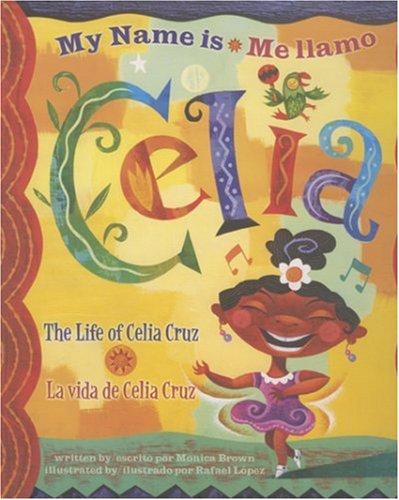
My Name is Celia/Me llamo Celia (Bilingual): The Life of Celia Cruz/la vida de Celia Cruz (Americas Award for Children's and Young Adult Literature. Winner (Awards))

This bilingual book allows young readers to enter Celia Cruz's life as she becomes a well-known singer in her homeland of Cuba, then moves to New York City and Miami where she and others create a new type of music called salsa.
Customer Review: Queen of Salsa
Celia Cruz is brought to life for young children in this colorful book. Like the tropics from which she came, the book is full of vibrant illustrations. The story is put into simple terms for young readers or a teacher or parent to read. Since the illustrations are so vibrant and bold children will be enthralled by the unique features of the art work. Each biographical page is bilingual for reading in Spanish or English or both. The book describes her early family life in Cuba, her departure after the revolution, her musical group Sonora Mantacera, meeting her musician husband,her associations with other salsa greats like Tito Puente and Willie Colon, her relocation to Miami and the various honors and recognitions she achieved. This is a great little book for primary and middle school libraries as well as community libraries. Students whoose first language is Spanish can benefit from the bilingual book through middle school years. This is a fun book.
Customer Review: Wonderful!
My Name is Celia: The Life of Celia Cruz is written by Monica Brown and illustrated by Rafael Lopez. The book is the recipient of a Pura Belpre' Illustrator Honor Award for outstanding work that portrays, affirms and celebrates the Latino cultural experience in an outstanding work of literature for children and youth. The exciting and inspirational life of beloved Cuban-born salsa queen, Celia Cruz, is celebrated in the bilingual book My Name is Celia Me Llamo Celia: The Life of Celia Cruz. Celia was born in Havana to a large family where their lives were intertwined and music was an important part of everyday life. Celia's papa wanted her to become a teacher but music filled her soul with happiness. She was encouraged by a teacher to "go out into the world and sing...." Celia experienced prejudice and fled her beloved country Cuba when the revolution began. From Cuba, Celia traveled the world sharing her love of music with the world. Rafael Lopez' illustrations are vibrant, fluid combinations of color that beg to be studied. The scenes fill the page and stir emotions as you read the story and live it through his drawings. Armchair Interviews says: My Name is Celia: The Life of Celia Cruz is a beautiful and educational addition to any child's library. We highly recommend it.


The origin of the word "art" can be traced back to the old English "thou art" which means "you are". Again, art as in "fine arts" owes its root to the Latin "ars" or "artis". However, in comparison to the dual meanings in which we may express the word, the second meaning has remained unchanged with the process of time. The word "culture" however originated from the Latin language. It said to have a Latin base "colere" which means to inhabit, to cultivate, or to honor. Broadly it can be said to be a human activity carrying several meanings and definitions.

The two distinct words "art and culture" if linked with each other, it exhibits two distinct concepts
  • Art may be a product of the extensive culture (cultivation) of human sentiments.

  • Culture of different strata of society at different places at different time has been expressed in art.
  • Art can be said to be a "result" of extensive culture of human emotions, sentiment and thought of an artist, supplemented with the artist's skill. It is a product of an artist's cultivation of different strata of society at various moments. Thus if one can culture on society at different situation, he can generate a good piece of art .So we may say that "art is a reflection of society" at different time.

    Practically time being the dictator in the evolution of society; it also influences a product of art. The classical period was a period of reason, order and rules.
    Art has thereby exhibited such meanings at that time.

    The Romantic period being a period of reasoning, so the dominant subject of art was emotion, adventure and imagination. Art in its cultural form gained impetus during the renaissance. Again, the 19th century culture was the theory of truth and beauty thus the form of art that came up during this period was based on "truth" and "beauty".

    Early 20th century culture brought forth the concept of modernism -this is the time, when the human nature was undergoing turmoil. The bizarre mundane society was undergoing a deviation from humanity at this time. The late 20th century is the postmodern period The puzzled society is now trapped in such a ditch that an exit from this phase is next to impossible. Men are said to have been transformed into robots. Junked up with work pressure they have little or no time to cherish their emotions and sentiments .The work of art that comes up at this stage are to call up an attention to human sentiment and art at large. The overall disjointed sentiment when cultured by an artist; it is reflected in the works of art through abstract expressions, images, ideas and concepts.

    Besides, a piece of art may also echo a specific culture. We may find several piece of art vividly exposing the "Byzantine culture". Again a work of art might focus on "Iranian culture", "western culture" or "modern culture" and so on. Moreover the art of working in a particular place at a particular time is the work culture. Likewise we have club culture or organizational culture.

    Actually art in its own form has developed itself with its multicultural heritage over time. Thus, it is worth saying that both art and culture are complimentary to each other and an overall support to each other to attain some sort of fulfillment at large.

    90s dance music

    Runaway


    The setting for the history of hoodia gordonii is southern Africa. Long before Europeans explored the continent giving Latin names to the strange plants and animals they encountered, the San peoples knew hoodia gordonii by different names; xshoba, ikhoba, xhooba, etc. The question of hoodia safety had long been answered for them. They knew that hoodia gordonii was safe to eat, though not a preferred food source. The history of hoodia gordonii as an appetite suppressant goes back to these people. When traveling or hunting they knew that hoodia gordonii would ease their hunger and thirst. There was no question about hoodia safety. It had been used traditionally to treat abdominal cramps and indigestion. It was even used to treat hypertension and diabetes. Questions of hoodia safety came later in the history of hoodia.

    Credit for giving the plant a Latin name goes originally to a botanist name Francis Masson, who sailed with James Cook. He called the plant Stapelia gordonii and wrote a book about it and other species of hoodia, which he called carrion flowers, because the blooms smell like rotting meat. Later on the name Stapelia was changed to hoodia, in honor of an ardent succulent grower named Van Hood. This begins the history of hoodia gordonii, by its current name.

    In the 1960s scientists at the Council for Scientific and Industrial Research (CSIR) investigated many African plants that were used by native people for medicinal purposes. They were interested in hoodia safety and effectiveness as an appetite suppressant. The scientists identified what they believe to be the active molecule in hoodia gordonii and patented the molecule. The recent history of hoodia gordonii scientific research begins here. The CSIR licensed a British pharmaceutical company to continue investigation of hoodia safety and effectiveness. Phytopharm sublicensed the rights to Pfizer, who returned the rights after closing their branch which dealt with plants and naturally occurring substances. Pfizer stated that they believed another company would be better equipped to continue research into hoodia safety and effectiveness. The history of hoodia and Pfizer ends here, in the late 1990s, and caused some questions among a very few people about whether or not Pfizer would have returned the developmental rights, if hoodia safety and effectiveness could be proven.

    Another opinion about Pfizers return of the hoodia license; often drug companies have several years to market their version of a new drug before anyone can market a generic or a similar natural health supplement. Because of Phytopharms long delay in bringing hoodia gordonii to the market (they are still involved in clinical research of hoodia safety and effectiveness), many health supplement companies have been able to obtain large supplies of the plant from farmers in South Africa. This actually begins the history of hoodia gordonii as a natural appetite suppressant. News continuously comes in. Just a few weeks ago (May 2006), Phytopharm announced that they and their new partner (Unilever) had just completed the first phase of a five phase clinical research program into hoodia safety and effectiveness. The world awaits the results.

    For more information about hoodia safety, visit the Hoodia Info Blog at http://hoodiainfo.blogspot.com.

    Patsy Hamilton is an editor of the Hoodia Info Blog.

    dance music 2007

    X&Y - Fully Autographed


    In recent years the addition of so many musical styles has emerged. Many people now want to learn how to play guitar. Unfortunately, most of these want-to-be guitar-players never make it past learning three chords. As a guitarists myself, I know the challenges of learning to play an instrument. I also know how to overcome most of these challenges. In this article I will be addressing a few challenges to learning how to play guitar and solutions for these challenges.

    1. Learning to play guitar takes hard work.

    The only place that success comes before hard work is in the dictionary. No matter how much God-given ability you have, you are not exempt from hard work. If you really want to learn how to play the guitar or any instrument for that matter, except for maybe the Kazoo, you must develop a habit of practicing. It takes the average person 21 days to develop a new habit. One thing that will help is to set aside a certain time everyday to practice and stick to this schedule even when you don't feel like it. Don't just plan on finding time to fit in a practice because it will never happen. You must schedule a 30 to 60 minute block of time each day. If you already have a full schedule, you may have to quit something else. It really just depends on how badly you desire to learn how to play and how much you are willing to sacrifice to accomplish this goal.

    2. Learning to play guitar means sore fingers.

    During the first few weeks of learning to play guitar, your fingers will be quite sore until you have developed calluses on your fingertips. This is an unavoidable reality of learning to play guitar and many people unfortunately quit due to soreness. The great news is that it's only temporary considering you are practicing regularly. The more you practice, the sooner your fingers will stop hurting.

    3. Learning to play guitar requires playing songs you may not enjoy.

    Most people want to learn guitar because they were inspired by someone or by some really cool riff. Unfortunately, most of the songs you love and desire to play are just out of your league in the beginning. You must first take the time to learn many basic fundamentals like chords, simple chord progressions and scales before you can tackle your favorite solos. Many people quit trying to learn guitar because they are so bored with the basics. Most worth-while endeavors in life will require the discipline necessary to endure the baby steps. One thing that will help you endure these baby steps is to keep the vision in front of you. Keep thinking about that really awesome riff that you will be able to play one day. Remember that you have to crawl before you can walk.

    4. Learning guitar requires good teaching.

    There are some good guitar instructors and some bad ones. Before spending your hard-earned money on just any person who claims that he or she can teach you to play guitar, check this person out. It's a good idea to ask for references. A good teacher should be able to provide these for you. Another option, and certainly a cheaper one, is to teach yourself via books and videos. Some of the best guitarists I know were self-taught. If you are a self-motivated type of person, I would highly recommend this latter option to you. There is a plethora of resources to help you learn how to play guitar.

    Playing guitar is very fun and rewarding; however it will take hard work and patience. If you really desire to play, keep dreaming about playing your favorite song or riff and keep this vision in front of you. This goal will keep you motivated and determined on those days that you just don't feel like practicing. If you have been dreaming of playing the guitar, go for your dreams. There is no better time than the present.

    Scott Brooks has been playing guitar for over 25 years. Are you ready to get started playing the guitar? Click here to sign up for a FREE six-part guitar teaching course.

    90s dance music

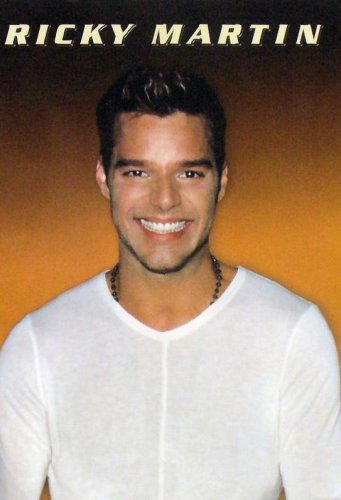
    Ricky Martin La Vida Loca Hot Latin Art Poster Print - 24" X 36"

    We bring you the best selection of Movie Posters, Music Posters, Sports Posters, Art Prints, Television Posters, College Humor, and more! This is the premier destindddfhttp://fgfdgf.comfff

    Karaoke is the act of singing along to recorded background music; it originates from Japan and in Japanese means empty orchestra.

    It is rumoured that karaoke was invented In Japan in the 1970s, when a Japanese musician was asked by fans to provide a recording of his performance so that they could sing along on their vacation. Realising this potential the musician then developed a machine that for 100 yen would play his songs; the machine was originally leased out and not immediately available in stores as they are nowadays. Unfortunately for the Japanese musician a Filipino businessman recognised the potential market for such a machine and patented a sing-a-long system to be sold in stores along with the music.

    Karaoke's popularity has lasted since its invention in the 1970's and has continued to be a popular form of entertainment and it has reached great success across the globe. Many bars, restaurants and clubs install karaoke machines into their venue, or hold karaoke nights to capitalise upon its popularity.

    The concept Curry Karaoke was developed in Glasgow; combining the nations two favourite things, Indian food and karaoke, with such CurryOke nights happening across the city it is no wonder that Glasgow has been named the Curry Capital of the UK. With the Ashoka restaurant on Elderslie Street offering a Curry Karaoke package of a private function suite, large Indian buffet, karaoke, party games and fancy dress outfits it sounds like Curry Karaoke is the ultimate in party nights. Providing an excellent alternative to your average birthday party or staff night out a Curry Karaoke night will provide endless fun, good food and some brilliant photo opportunities; most definitely a different kind of night out.

    Visit the Ashoka Website for a menu and photographs from the many Curry Karaoke nights that they put on.

    90's dance music

    Rosetta Stone V3: Spanish (Latin America), Level 2

    Spanish (Latin America) Level 2 teaches you to navigate through your surroundings as you build on the vocabulary and essential structure in Level 1. Learn to talk about your environment such as giving and getting directions, using transportation, telling time, dining out, enjoying basic social interactions and more.
    Customer Review: a software note
    This product is sold as licensed software. Users will NOT be able to load it onto more than one computer. This aspect of the product is not clear from the blurbing on the Rosetta Stone website. It is a "single-user" product. Don't think that you can share this with friends, or that it is appropriate for a lending collection.
    Customer Review: Wonderful Learning Tool
    I gave this as a gift to someone with a minimal background in Spanish, but a great desire to learn. He loves it. It has inspired him to keep to the instruction modules and is now peppering all of his speech with the words and phrases he's learned.


    Throughout the essay, I will explore other reformers and sects who followed in Luther's wake to challenge the established religious ways. I will be concentrating on Zwingli; Calvin, and the Anabaptists. I will expound upon the main differences between their religious interpretation and Luther's own positions.

    Like Luther, Zwingli; Calvin, and the Anabaptists contributed to the great Reformation - the reformation that hastened the Disintegration or the Dissolution of the Medieval Catholic Church during the Disintegration period of the 14th century to the 15th century, and beyond. Muentzer, who instigated the 1525 Peasant Rebellion while Luther was under the protection of Fredrick the Wise, was more radical than Luther. Muentzer wanted to reform the temporal aspects of the Reformation. Hence, he wanted to abolish serfdom on the basis of 'true Christianity.' Luther denounced Muentzer (a German monk and Luther's friend) for his radicalism. Luther stated Muentzer's execution was God's punishment on him.

    Zwingli is a Swiss nationalist and reformer based in Zurich. He agreed with Luther on most points. However, Zwingli disagreed with Luther on Consubstantiation.

    Zwingli argued the word 'is used in its Greek/Latin form means'signify'. Therefore, the Communion is neither a rite of Transubstantiation nor Consubstantiation. Rather, the Communion is 'a memorial service' of our Lord and Savior Jesus Christ.

    Zwingli's disagreement created a mountain between himself and Luther. As a matter of fact, the Swiss Protestants under Zwingli were not supported by Luther's German Protestants in their war against the Catholic forces because of their disagreement (carved by Luther on a negotiating table, "This is my body" in Latin). The disagreement was so sore that Luther exclaimed, 'he got what he deserved.... His death proved I'm right and he's wrong; upon hearing of Zwingli's demise in battle (a Bible in one hand and a sword in the other).

    Calvin, a French transplant based in Geneva, shared many points with Luther. However, like Zwingli, Calvin believed the Communion is a 'Memorial Service' instead of a Consubstantiation. Luther believed what's not in the Bible, is allowed - for example, singing and dancing. In contrast, Calvin believed everything that's not supported by Scriptures is forbidden by God, including singing and dancing.

    Calvin was more extreme than Luther as per 'the doctrine of Predestination.' For example, God chooses who is going to Heaven and damned others to go to Hell. Calvin wanted to create 'a new Jerusalem' on earth (via Geneva). He believed in good living (capitalistic somewhat) of Christians (Christians should be the best they can be....)

    The Anabaptists is a sect that spread all over Europe. Today, the Amish sects are descendants of the Anabaptists. Unlike Luther, the Anabaptists only believe in adult baptism (hence their name). They reject oaths, swearing, violence and etc. They believe man should imitate Christ. Thus, the Anabaptists are the true elect of the Church. The Anabaptists were harshly persecuted by both the Catholics and other Protestant sects because of their aforementioned beliefs (which they consider a threat to the security of society). Nonetheless, an Anabaptist sect led by John of Leyden violently took over a town named Munster. This Anabaptist sect was the exception as per their use of violence. They were defeated, eventually. The leaders were hung in a cage by a church in the town of Munster as stated by the esteemed historian - Dr. Wladyslaw Roczniak.

    In conclusion, I explored other reformers and sects who followed I Luther's wake to challenge the established religious ways. Plus, I concentrated on Zwingli, Calvin and the Anabaptists. I expounded upon the main differences between their religious interpretation and Luther's own positions.

    Karl A. Mitchell

    latin music lyrics

    Best of


    Starting new things for your child sometime difficult, but you still have to do it. Potty training is one phase that your child has to go through. So, find out when is your child ready for potty training. Here are those five ready signs:

    1. Takes Off Own Clothes

    Lets face it. The first step to becoming dry begins with your toddlers ability to recognize he has to go to the bathroom. The second step is his ability to pull down his pants, or lift up her dress. The third step is actually going to use the potty. If your child begins insisting on taking off his clothes then he probably is ready to begin training for the potty.

    2. Talks about Using the Potty

    He may say, I want to use the potty. Or, he may just point to it and sit down. Either case he is showing an extreme interest in the little chair. Well, what do you do if hes interested in sitting; maybe hell be interested in using it. You never know unless you try. Hey diapers are expensive why spend more on them if you dont have to.

    3. Does a Potty Dance?

    There are some children doing potty dance? Does your little one have a routine? Does he stomp, turn, twist, and grab his groin like Michael Jackson? If he does, then thats his potty dance. Hes ready, ready, and ready if he has his own version and he dances it whether theres music on or not.

    4. Shows an Interest in the Bathroom or Toilet

    This is the big koruna of all ready signs. The big earthquake so to speak. If your child is curious about the bathroom or toilet, then hes ready to learn how to use it. Is he curious about how it flushes? Well, thats because he wants to know how that giant white chair works. Why does it make that sound? Its a noise like no other. Hes not being bad when you have to drag him out of the toilet. He wants to know what the toilet is. He wants to know how it works. He is ready, ready, and ready for potty training.

    5. Stays Dry Overnight & During Naps

    This is a hard readiness sign to understand. If you child staying dry overnights and at naptime that is the sign that he is ready for potty training. In any event, your child is ready if he displays this sign.

    Now, does your child exhibit any two of these ready signs? If so, then get ready to do your potty training. You will never know those signs if you are not pay attention to their reaction.

    About The Author: Janice Caller, author of "A Parent's Guide to Toddling, From Diapers to the Pot." She successfully potty trained her four children. Visit her Website PottyTrainingGuide.com at http://www.pottytrainingguide.com

    90's dance music

    GARBAGE - Androgyny - Navy Blue T-shirt

    Brand New, never worn, front print navy blue Authentic GARBAGE T-shirt.


    Singing lessons are very useful for those of us who love to sing and would like to improve our vocal technique as well as our overall pitch and rhythm sense. However, some singing students may be a little overwhelmed whenever they attend lessons, and may not know how to best make use of the time that they have with their vocal coach or singing instructor!

    Here are some important tips for all singing students, so that you will be able to make the most out of your singing lessons, and be able to improve quickly in your singing and vocal technique:

    Get A Good Vocal Coach

    For your vocal lessons to be genuinely useful to you in developing a better singing voice, you will need an experienced vocal coach who is able to 'diagnose' your voice and know exactly what exercises you will need in order to improve your singing! For example, you may need more exercises to strengthen your chest voice, or more pitching or rhythm training, or even some basic lessons in pronunciation and diction. Your vocal coach should be able to tell you what you need, and be able to communicate these ideas to your clearly!

    Always Come Prepared For Lessons

    Every singing lesson is an opportunity for you to talk to an expert in singing and to learn as much as you can from your vocal coach! So, always come prepared with questions that you may have had during the past week or are genuinely curious about. This will show your vocal coach that you are motivated about learning how to sing, and he or she will be more inclined to teach you even more! Your instructor will also be able to understand better what are your main concerns and how best to answer them so that you will be able to improve even more!

    Practice, Practice and More Practice

    Make sure you practice whatever vocal drills or pitching exercises that your singing instructor has given you during the singing lessons. Learning how to sing is just like learning how to play any musical instrument, and as with any instrument, practice is absolutely essential if we want to improve in our playing or singing skills! Also, pay attention to how you practiced during your lesson with your vocal instructor so that when you practice at home, you know how to do it correctly and certainly not inadvertently harm your voice during your self-practice!

    Be Patient

    Learning how to sing well takes some time and effort, and certainly does not happen overnight. Just like how it takes a piano player many years before he or she is able to be great at playing the piano, so it will also take us a certain period of time before we are able to master our singing voice! Even professional singers take regular singing lessons to keep their voices in top form, and to keep improving in their vocal technique!

    One reason for a longer learning curve is because our voice learns through what we call 'muscle memory'. Many of the functions of our vocal cords and voice box are involuntary reflexes that we cannot control consciously. In order for us to correct our singing habits, we need to practice positive reinforcement through muscle memory, using the correct singing methods often so that our voice and our brain remembers them and uses them each time we sing!

    Enjoy The Learning Process

    One great thing about singing is that it is fun and enjoyable even during proper lessons, and we would certainly be able to enjoy the learning process that we must go through in order to get a better singing voice! Once we accept the long learning process, we will certainly be more relaxed during our lessons and be able to improve our voice even more! It is a virtuous cycle that singing students will be able to benefit from with the correct mindset and attitude.

    With these important pointers in mind each time we attend our singing lessons, we will certainly be able to get the most out of our lessons and achieve a great singing voice through practice and patience!

    Singapore-born Aaron Lim has been a Vocal Coach for the past 8 years, and has taught a variety of vocal students ranging from teenagers to mature adults. He is the founder of an online singing guide: http://www.your-personal-singing-guide.com , which provides a wealth of resources and tips available for any singer! Find out everything you want to learn about singing from this useful and comprehensive website!

    Aaron is also the director of Intune Music School, a dynamic and vibrant music school in Singapore that provides professional music programmes in singing, songwriting, keyboard and guitar sing and play, music arrangement and audio engineering! Find out more by visiting the school website at: http://www.intunemusic.com.sg

    latin jazz music

    Ultimate Santana

    2008 reissue housed in a deluxe cardboard slipcase. This single disc anthology brings the legendary guitarist's best recordings of his Arista Records era together with his greatest classics from the Columbia Records years on a single compact disc. Among the 18 tracks are the chart toppers 'Smooth', 'Maria Maria', 'Black Magic Woman', 'The Game Of Love' (with both Michelle Branch and Tina Turner), 'Oye Como Va' and many more. Sony/BMG.
    Customer Review: big mistake
    YUK! I just recently started downloading mp3s and really screwed up when I bought this thinking it would be the Carlos Santana music I knew in the 60s. What else would "Ulitmate Santana" mean? Instead most of the album is just Santana accompanying some bozo singing stupid disco type songs. My bad. Remember, when it says "featuring so-and-so" it usually means you better like so-and-so and not care too much about who the titled performer is.
    Customer Review: Great songs, but...
    Carlos Santana has very few bad albums, or even bad songs. (Stay away from his collaboration with John McLaughlin though.) If you're looking for a one-disk compilation and are familiar with his later songs plus his late 60's hits, the songs here will be familiar. But... try Caravanserai, Borboletta, or some of his other unbelievable albums from "in between". If this is all you know of Carlos Santana, you have a lot to discover! What you hear on this disk is just an introduction. I give this review 4 stars rather than 5 not because there are bad songs on this CD (there aren't), but because you, as a Santana listener, deserve more.


    It is actually very sad, and at the same time funny to be presenting papers, or conducting workshops on Peacebuilding through the Arts because Arts is really about peace-it has one and the same meaning, only the spelling is different. Yet, time and again, we have to convince other people, especially funding bodies that what we do is essentially peacemaking.

    An example of how Art equals Peace is this experience I had when I attended the Flying Circus Project 2000 in Singapore. The 21-day workshop-interaction organized by Theatreworks, Ltd. based in Singapore gathered 75 dance, theatre, music, traditional, visual, and film artists all over Asia, many of who did not speak English. Of course there were translators. All the time, we were sitting on the floor in circles or semi-circles. There were sessions where we would listen to an artist resource person who would share his/her work. We would watch live performances, video shows, and slideshow presentations of these artists' works, after which, we would talk endlessly about the presentation, where we argued a lot. Some discussions became heated or boring enough for some of us to leave these sessions. The only time that we laughed together and felt our kinship and solidarity was when we performed together. These were the moments of pure peace and contentment. In the end, some of us who have become real friends agreed in one of our over-lunch tet-a-tets that whenever we opened our mouths to talk about an idea and try to convince the others about this idea, an argument ensues. But all philosophical and pedagogical differences are wiped out when we break into song or dance.

    ART AS A RELATIONSHIP

    Art is about reflecting your life, another person's life, or another creature's life on stage, on canvass, and in verses, the difference being an entire life is captured in a few moments of performance (theatre) and exposure (film), a few strokes (painting), or a few words (poetry).

    But art as a mirror requires: 1) knowledge and understanding of the subject, and 2) communication. When you try to paint a stone, you are actually trying to understand what a stone feels like, where its curves lie, why it's chipped on one side. When a performer portrays the role of a devil or a dictator, s/he tries to put him/herself on that creature's shoes and tries to feel what that creature is feeling.

    Art is about communication. When you paint a picture and hang it on the wall, people are bound to look at it and even try to analyze it. They may or may not get what you're trying to say, but the fact that people actually stop and look and try, if desperately, to understand that piece of work, is the beginning of real communication.

    A lot of conflicts are the result of the lack of communication.

    Artists project onto the canvas, or paper, or onstage their feelings and thoughts and philosophies about certain subject matters. When a child draws on paper what seems to be senseless, vigorous strokes of scratches and lines and endless circles, the child may be trying to say I am disturbed, I am angry, I am hopeless. An ordinary person seeing this piece of confused work is actually seeing a piece of art drawn by a child trying to say that his/her life is, indeed, confused.

    ART AS A BLIND PERSON'S JOURNEY

    Art is about magnifying or detailing certain things about life. Artists notice lots of things around us that "non-artists" don't. A blind person carries with him/her sensibilities and sensitivities akin to that of an artist. Because a blind person does not have visual references which to hang on to, all his/her other senses compensate for a visual disability by working double time, and twice over. So do artists. They are very keen at observing little things, mostly things that we take for granted, like cracks on walls, and a blade of grass bent in another direction.

    As a non-blind person doing a blind person's journey, you are actually afraid to take a step forward because you are thrown in a different perspective, presented with a different point of view. A lot of biases and conflicts arise from very set beliefs, opinions, cultural patterns, and political frameworks borne out of years of social conditioning in the homes, in schools, on TV, in movies, etc. So when another point of view is presented to you-one that you have not experienced, the immediate reaction is resistance, a refusal to take that crucial first step forward and embrace that new space, that new dimension, in order to understand more comprehensively the world and how it works.

    It is common to think of artists as free spirits, good-only-for-entertainment human beings. I was once invited to sing in a women's conference and I was introduced as an artist with no political stand or affiliations but they invited me because I was a woman and I knew a few women's songs. We have common mis-perceptions of artists as having no political backbone, when in fact many of our artistic creations-whether they are paintings of a fish or stars or flowers-are political. The images that we show are our political statements. "Nature is beautiful" is as much political as the statement "stop the war."

    And with art, everything is beautiful. Even your anger, when expressed on a piece of paper, is a beautiful thing. In this sense, artists are, indeed, blind.

    ART AS A TOOL FOR HEALING AND PEACEMAKING

    In the olden days in some indigenous communities, two people expressed their anger for each other by chanting or playing the flute or some other instrument. Imagine a world where arguments are settled through song.

    When we're really stressed out, angry, or depressed, we go out and watch a movie (film arts), we gormandize on food (culinary arts), we splurge on new clothes (fashion arts), we listen to classical or rock music (music arts).

    Art is everywhere-it is as basic as food, without which we'd all be killing each other, which is what is happening now, because there isn't enough art to serve 70 million Filipinos, for example. To calm ourselves and make this world a "peaceful" place to live in, we kill those who make us angry. We kill over parking space. We kill over an uncooked dinner.

    Because art has become inaccessible. You need money to watch a movie. You need money to buy food. You need money to buy clothes. You need money to buy a cd playern or an ipod. You need money to buy costumes and make-up and paint and canvasses and stage props. Poverty and inequity has reduced art into an activity available only to a select few. And those who have so much produce entertainment shows and other pseudo-art that reinforces poverty and inequity. And the cycle goes on.

    PEOPLE AS PRODUCERS, RATHER THAN CONSUMERS OF ART

    Herein lies the difference, the gap, and the greatest challenge for us all as peacemakers and peacebuilders. More often than not, we are consumers, rather than producers of art. But do you notice how children-especially poor children-are the best examples of art producers, yet little do we recognize their natural artistic talents? In the absence of money to buy toys, poor children create toys out of tin cans, stones, leaves, found objects-in adult terms, appropriate technology. This is their way of handling poverty. But this is not enough.

    How we translate or elevate these natural talents into a conscious, institutionalized and programmatic art-making is the challenge for development workers and especially for government-so that art, which was once upon a time a language spoken by every member of the community, is reclaimed by every single human being as his/her own.

    Imagine a world where every human being is an artist.

    http://www.musicanthology.org

    80's dance music