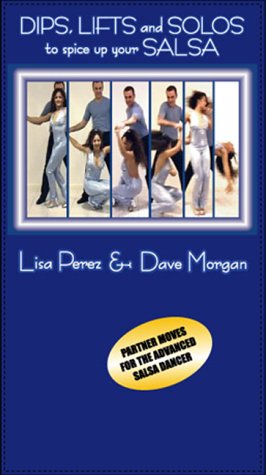
 Dips, Lifts, and Solos to Spice up Your Salsa
 Featuring: Lisa Perez and Dave Morgan
Directed by Lee Soto Edited by Dave Morgan Distributed by Barrio Records
Customer Review: Weeeeeeell.....
The dips and lifts part is good. There isn't much instruction for the woman on this video other than curl your arm, keep clean lines, and other few things pointed out. I guess if you have a good leader and you are a good follower you wouldn't need much. I was disappointed with the solo part. I was expecting more instruction but she just does her thing and i guess you are supposed to learn by watching. I really would have preferred a breakdown. They did include a breakdown in the lifts that follow the solo. Overall, its pretty good, especially for the men or anyone leading, but found a little lacking on the woman's part.
Customer Review: Good selection
I would recommend this tape to anyone out there. The moves are excellant and well presented. If anything the lighting could have been better and there was too much space on the set such that the people seem to be too far back and you can't see their facial details. These are minor details however in the dance scheme of things. Good work overall.
Origin:
Samba originated in Brazil, with the music containing a combination of Iberian, Native and African influences. The modern day Samba as we know it was developed from a Brazilian style called Choro. Samba is a big part of the world famous carnival parade, and nicely compliments the Bateria.
Music:
Samba has a lot of variations, but most variations have one thing in common: A heavy percussion presence. Samba Music is played in 2/4. The common modern day Samba has the Pandeiro as the most common percussion instrument. The Violo is the other instrument which is always present. The music can vary across all themes, and is not specific to any them or emotion.
Dance:
Samba's most common dance variation is "Samba no p" which is a solo dance. Men dance with their whole feet on the ground, whereas women usually dance using the balls of their feet. The rythm is played in 2/4 and the stepping is called as "and-a-one and-a-two". The knees are used a lot in Samba, with one knee bending at a time with the upper body straight.
Latinos NZ Popularity Scale: 5/10
Samba is slowly becoming more popular in New Zealand, although Latin Clubs tend to stick to other forms of Latin Music. However, some clubs now have Samba Nights with Samba and other Brazilian rythms and dance.
New Zealand's biggest Samba event is Jambalaya. Don't miss it next time!
Article taken from Latinos.co.nz (http://www.latinos.co.nz)
latin music festival
No comments:
Post a Comment