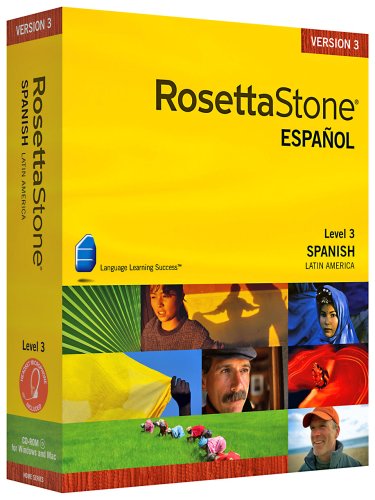
 Why is Rosetta Stone the world's No. 1 language-learning software? Because it works.
 Escape the endless tedium of translation, memorization, and grammar drills. Get the language you want, the skills you need and the success you deserve by learning a new language naturally--the same way you learned your first language.
 |  | |
 The complete immersion environment puts your native language-learning skills to work, eliminating your dependence on tedious translation and rote memorization. | | |
 |  |
| | |||
 Images Images |  |  Intuition Intuition | ||
| ||||
In Rosetta Stone you learn the meaning of new language from clear, real-life images.
In this activity you learn colors. | | You advance using language you've learned and clues from new images. That's your intuition at work.
Now that you know colors, you can easily grasp the meaning of the new words... | ||
| ||||
 Interactivity Interactivity | |  Instruction Instruction | ||
Throughout Rosetta Stone, you constantly interact with the program to confirm your intuition.
...and then check what you've learned. | | From beginning to end you build systematically toward your language-learning goals, for the most effective and enjoyable instruction anywhere.
And finally, you get the fun of trying your new language in a real-life simulation. Speech recognition shows you exactly how you're doing. | ||
| | |||


You learned your first language without translation.
You learned your first language easily and naturally by connecting words to objects and events around you. With Rosetta Stone, learn a new language the same way: using native speakers and thousands of real-life images to help you think in the new language from the very beginning. Studies show that learning exclusively in the new language, without translation as a crutch, is crucial.
The exclusive Dynamic Immersion method reinforces your natural language-learning skills with award-winning instructional technology. Identify your learning goals, then choose customized courses that take you there.
The timeless immersion method, along with research-based techniques and new technologies, make Rosetta Stone the clear solution to your language-learning needs.
What will you be able to do?
Understand everyday language.
Through Rosetta Stone's proficiency-based listening and reading activities, you'll learn quickly.
Pronounce words correctly.
After practicing with Rosetta Stone's speech recognition and analysis tools, pronunciation will come easily.
Speak without a script.
Contextual Formation makes sure you have the confidence and cues you need to get the words out on the spot.
Spell and write accurately.
You'll build gradually from letters to words and sentences.
Engage in real-life conversations.
With Milestone activities, gain confidence using speech alone in simulated situations.
Retain what you learn.
The unique Adaptive Recall reinforces language so it sticks with you in the real world.
Customer Review: great system
I am now on the 3rd and final level of Rosetta Stone's Spanish (Latin America). I have been very impressed with the series. I do also use Pimsleur Spanish CDs in my car to supplement my learning. I'd recommend both to anyone interested in learning any language.
Customer Review: Installation challenges
This version is sold as Vista compatible, however installation was not straight forward with Vista Ultimate as operating system. Once installed there is an error message as the file framedynos.dll is not found. We needed to copy it into the program directory. The activation program does not work with Vista, we needed to disconnect the PC from the internet and activate via phone. Neither of these two problems was listed in the manual. The good thing was that the phone service was available even late in the night. Once these two hurdles were overcome the program seems to be working well.
If you are interested in beats, then you are sure to be interested in other instruments besides the usual drums that can give you the right beats. Well then let us discuss bongos and congas from the family of drums.
Bongo is a small version of drums. Actually it is a compilation of two open-ended drums. These two drums are joined with each other. Drum heads are normally made of animal skins, but plastic made drum heads are also available. The body is made of metal, wood and sometimes with ceramic also. Both the bongos are of different size. And for that reason each of them sounds different. You have to coordinate between both of them, to play it well.
A pair of simple bongos does not have those stretchable drum heads that can be tuned to play different notes from different parts. But the better quality bongos have this option. Their heads are adjustable. These heads are fixed firmly with metal made bars.
The way of playing bongos is very interesting. You have to use your finger strips, heel of your hand and thumbs. You need to strike the heads with the help of these hand parts. Striking different place of the head will produce different sound. Special drum oil is necessary to protect the head of the bongo. Otherwise your hand and the air will absorb all the moisture of the bongo skin. This will make the bongo skin dry. It can also pave way for cracks.
The best thing about bongo is that it is small, and not very much expensive. And if you know how to play it and if you have some friends who can play bongo, then you can form a band. If all of you play together some small groove then it will sound amazing.
Conga is almost like bongo. But it measures quite high in comparison to other drums. It is slim build and single headed. It is a Cuban drum but probably it is derived from Africa.
The shells of most of the congas are made of wood or fiberglass. The playing system of conga is almost like bongo. They are normally 75cm tall.
Congas are used in both popular and folk music. African music has a varied use of congas. This instrument is also very popular in Rumba, Afro Caribbean, Latin and salsa music.
Bongos and congas are almost similar kind of instrument. But former are smaller than latter. There sound is not totally similar but they are not that much different also.
Both are rhythm instruments. Their playing style is almost same. Both of them are very popular. They can be used in almost every kind of music.
But there are some difference between bongos and congas. Bongos are easy to carry. But congas are not. Both of them have a different look also. Congo just looks a bigger version of bongo usually. But if you watch closely and minutely, then you can trace the difference. But whatever is the difference is, it can be said that both bongos and congas are brilliant instruments. And both of them can change the way a particular song sounds.
Victor Epand is an expert consultant for guitars, drums, and synthesizers. You can find the best marketplace for guitars, drums, and synthesizers at these 3 sites: guitars, drums, bongo, conga, drum heads, and synthesizers, keyboards.
dance music charts
No comments:
Post a Comment