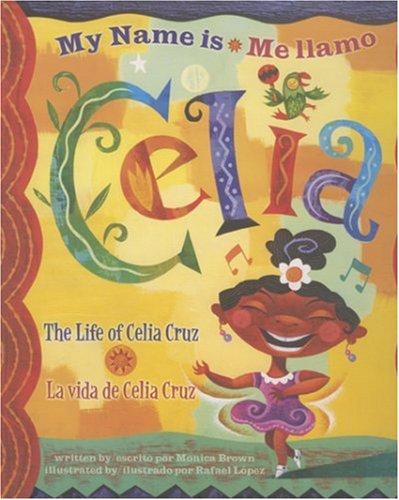
 This bilingual book allows young readers to enter Celia Cruz's life as she becomes a well-known singer in her homeland of Cuba, then moves to New York City and Miami where she and others create a new type of music called salsa.
Customer Review: Queen of Salsa
Celia Cruz is brought to life for young children in this colorful book. Like the tropics from which she came, the book is full of vibrant illustrations. The story is put into simple terms for young readers or a teacher or parent to read. Since the illustrations are so vibrant and bold children will be enthralled by the unique features of the art work. Each biographical page is bilingual for reading in Spanish or English or both. The book describes her early family life in Cuba, her departure after the revolution, her musical group Sonora Mantacera, meeting her musician husband,her associations with other salsa greats like Tito Puente and Willie Colon, her relocation to Miami and the various honors and recognitions she achieved. This is a great little book for primary and middle school libraries as well as community libraries. Students whoose first language is Spanish can benefit from the bilingual book through middle school years. This is a fun book.
Customer Review: Wonderful!
My Name is Celia: The Life of Celia Cruz is written by Monica Brown and illustrated by Rafael Lopez. The book is the recipient of a Pura Belpre' Illustrator Honor Award for outstanding work that portrays, affirms and celebrates the Latino cultural experience in an outstanding work of literature for children and youth. The exciting and inspirational life of beloved Cuban-born salsa queen, Celia Cruz, is celebrated in the bilingual book My Name is Celia Me Llamo Celia: The Life of Celia Cruz. Celia was born in Havana to a large family where their lives were intertwined and music was an important part of everyday life. Celia's papa wanted her to become a teacher but music filled her soul with happiness. She was encouraged by a teacher to "go out into the world and sing...." Celia experienced prejudice and fled her beloved country Cuba when the revolution began. From Cuba, Celia traveled the world sharing her love of music with the world. Rafael Lopez' illustrations are vibrant, fluid combinations of color that beg to be studied. The scenes fill the page and stir emotions as you read the story and live it through his drawings. Armchair Interviews says: My Name is Celia: The Life of Celia Cruz is a beautiful and educational addition to any child's library. We highly recommend it.
The origin of the word "art" can be traced back to the old English "thou art" which means "you are". Again, art as in "fine arts" owes its root to the Latin "ars" or "artis". However, in comparison to the dual meanings in which we may express the word, the second meaning has remained unchanged with the process of time. The word "culture" however originated from the Latin language. It said to have a Latin base "colere" which means to inhabit, to cultivate, or to honor. Broadly it can be said to be a human activity carrying several meanings and definitions.
The two distinct words "art and culture" if linked with each other, it exhibits two distinct conceptsArt can be said to be a "result" of extensive culture of human emotions, sentiment and thought of an artist, supplemented with the artist's skill. It is a product of an artist's cultivation of different strata of society at various moments. Thus if one can culture on society at different situation, he can generate a good piece of art .So we may say that "art is a reflection of society" at different time.
Practically time being the dictator in the evolution of society; it also influences a product of art. The classical period was a period of reason, order and rules.
Art has thereby exhibited such meanings at that time.
The Romantic period being a period of reasoning, so the dominant subject of art was emotion, adventure and imagination. Art in its cultural form gained impetus during the renaissance. Again, the 19th century culture was the theory of truth and beauty thus the form of art that came up during this period was based on "truth" and "beauty".
Early 20th century culture brought forth the concept of modernism -this is the time, when the human nature was undergoing turmoil. The bizarre mundane society was undergoing a deviation from humanity at this time. The late 20th century is the postmodern period The puzzled society is now trapped in such a ditch that an exit from this phase is next to impossible. Men are said to have been transformed into robots. Junked up with work pressure they have little or no time to cherish their emotions and sentiments .The work of art that comes up at this stage are to call up an attention to human sentiment and art at large. The overall disjointed sentiment when cultured by an artist; it is reflected in the works of art through abstract expressions, images, ideas and concepts.
Besides, a piece of art may also echo a specific culture. We may find several piece of art vividly exposing the "Byzantine culture". Again a work of art might focus on "Iranian culture", "western culture" or "modern culture" and so on. Moreover the art of working in a particular place at a particular time is the work culture. Likewise we have club culture or organizational culture.
Actually art in its own form has developed itself with its multicultural heritage over time. Thus, it is worth saying that both art and culture are complimentary to each other and an overall support to each other to attain some sort of fulfillment at large.
90s dance music
No comments:
Post a Comment